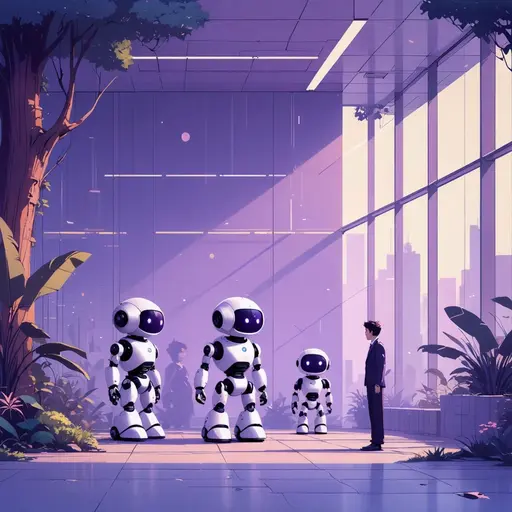
AI Agents in the Workplace: Reshaping the Future of Work
The AI Agent Revolution: From Digital Assistants to Co-Workers
Have you ever wondered what it would be like to have an AI as your co-worker? Well, that future might be closer than you think. The world of artificial intelligence is evolving at breakneck speed, and with it comes a new breed of digital helpers: AI Agents. These aren't your run-of-the-mill chatbots or simple automation tools. We're talking about sophisticated, autonomous entities that could revolutionize the way we work.
But as with any rapidly advancing technology, there's a cloud of confusion surrounding AI Agents. What exactly are they? How do they differ from the AI tools we're already using? And most importantly, how will they reshape our workplaces?
Decoding the AI Agent Terminology Tangle
If you're feeling overwhelmed by the barrage of AI-related terms, you're not alone. The tech industry has been on a naming spree, introducing a dizzying array of concepts:
- Generative AI (GenAI)
- Agentic AI
- Autonomous Agents
- Copilots
- Multimodal AI
- AI Coaches
It's enough to make even seasoned IT professionals scratch their heads. But don't worry – we're here to cut through the jargon and get to the heart of what AI Agents really are.
AI Agents vs. Automated Workflows: Drawing the Line
To understand AI Agents, let's first clarify what they're not. Many tools marketed as "agents" today are essentially sophisticated automation tools or custom-trained prompts. They might help you manage emails or schedule meetings, but they lack true autonomy.
So, what sets a genuine AI Agent apart? Think of it as the difference between a helpful assistant who follows your instructions and a proactive colleague who anticipates needs and takes initiative. True AI Agents should be:
- Autonomous: Capable of making decisions and taking actions without constant human input
- Proactive: Able to identify tasks and opportunities without being prompted
- End-to-end capable: Skilled at handling complex processes from start to finish
- Adaptive: Capable of learning and improving over time
The Current State of AI Agent Technology
While we're not quite at the level of fully autonomous digital colleagues, we're making significant strides. Companies like Salesforce are introducing tools like "Agentforce" that showcase the potential of AI Agents. These systems are taking on increasingly complex tasks, from data analysis to customer interactions, with minimal human oversight.
From Digital Assistants to Co-Workers: The Evolution of AI
As we navigate this new landscape of AI in the workplace, you might find yourself wondering how these digital co-workers will fit into your daily routine. The terminology is evolving alongside the technology, reflecting a shift in how we perceive these AI entities.
NVIDIA's Vision: AI as Colleagues
At CES, NVIDIA's CEO Jensen Huang proposed a thought-provoking shift in terminology. Instead of "agents," he suggested we think of these AI systems as "co-workers." This isn't just a semantic change – it represents a fundamental reimagining of AI's role in the workplace.
Imagine a future where:
- AI sales agents negotiate deals with other AI systems, handling 85% of the process autonomously
- Your inbox is managed primarily by an AI, with only the most critical messages requiring your attention
- Complex data analysis and report generation happen in the background, with AI co-workers presenting you with actionable insights
This vision goes far beyond our current AI implementations, which still require significant human oversight and input.
The Economic and Social Impact of AI Agents
As AI Agents become more capable and autonomous, they raise profound economic and societal questions. One of the most pressing is: As these digital workers take on roles that generate significant revenue, should they be taxed as employees?
The AI Taxation Debate
This idea isn't entirely new – it echoes Bill Gates' 1990s proposal to tax robots. Proponents argue that taxing AI systems could help offset the economic disruption caused by job displacement. Critics, however, contend that AI Agents are fundamentally different from human workers, and taxing them could stifle innovation.
Regardless of where you stand on this issue, it's clear that the rise of AI Agents will have far-reaching implications for:
- Employment patterns
- Economic structures
- Social safety nets
- Education and skill development
As we integrate these digital co-workers into our organizations, we'll need to grapple with these challenges head-on.
Preparing for an AI-Augmented Workplace
Think of AI Agents as the Swiss Army knives of the digital world - versatile, always at hand, and ready to tackle a wide array of tasks at a moment's notice. But like any powerful tool, they require proper management and integration.
The Evolving Role of IT Departments
As AI Agents become more prevalent, IT departments may find themselves taking on a role akin to HR for digital workers. This could involve:
- Selecting and "hiring" appropriate AI systems
- Integrating AI Agents into existing workflows
- Managing AI performance and "upskilling"
- Ensuring ethical use and compliance
This shift represents a significant evolution in the IT function, requiring new skills and perspectives from technology professionals.
The Future of AI Agents: Opportunities and Challenges
As we look to the future, the potential of AI Agents is both exciting and daunting. We might see:
- Meetings attended entirely by AI Agents, negotiating deals and making decisions
- AI-driven innovation, with agents collaborating to solve complex problems
- Personalized AI assistants that understand our work styles and preferences intimately
However, realizing this potential comes with significant challenges:
Ethical Considerations and Industry Standards
As AI Agents become more autonomous and influential, we'll need to address critical questions:
- How do we ensure AI decisions align with human values and ethics?
- What standards should govern the development and deployment of AI Agents?
- How do we maintain human oversight and control over critical processes?
Embracing the AI Agent Era: A New Chapter in Work
The rise of AI Agents in the workplace isn't just another technological trend – it's the beginning of a new era in how we work, collaborate, and create value. As these digital co-workers become more sophisticated and integrated into our daily lives, they promise to enhance our capabilities, free us from mundane tasks, and open up new realms of possibility.
But realizing this potential requires more than just technological advancement. It demands a reimagining of organizational structures, a reevaluation of economic models, and a commitment to ethical, human-centered AI development.
As we stand on the brink of this AI-augmented future, one thing is clear: The way we work will never be the same. The question is, are we ready to embrace our new digital colleagues and shape a future where humans and AI Agents work side by side, each leveraging their unique strengths to create something greater than the sum of their parts?
The AI Agent revolution is here. It's time to welcome our new co-workers and write the next chapter in the story of work together.